

| Inflation is falling, and the US, China, Germany, Japan, and India lead global economies in 2024 | India’s elections were lengthy, while the global population reached 8.2 billion and is set to peak by 2080 | Markets showed resilience in 2024, with moderate volatility as the VIX averaged 15.5 |
- Global headline inflation – is expected to fall from an annual average of 6.7% in 2023 to 5.8% in 2024 and 4.3% in 2025, with advanced economies returning to their inflation targets sooner than emerging market and developing economies (IMF)
- Global unemployment – is estimated at 4.9%, a slight decrease from 5% in 2023 (ILO)
- Top 5 largest global economies (by GDP in 2024) – US ($29.17tn), China ($18.27tn), Germany ($4.71tn), Japan ($4.07 tn) and India ($3.89tn) (IMF)
- And the 6th largest global economy (by GDP in 2024) – UK $3.59tn (IMF)
- 2024 India election – the world’s most populous democracy held its general election over a seven-phase period that lasted 44 days!
- Donald Trump will re-enter the White House – at the age of 78, the global debate about political age limits is expected to intensify in 2025 (The Economist)
- Energy Transition – renewables accounted for over one third of global electricity generation, a record high (IEA)
- Population milestone – the global population reached 8.2 billion in 2024, with growth concentrated in Asia and Africa. The world’s population is expected to continue growing for another 50 or 60 years, reaching a peak of around 10.3 billion people in the mid-2080s (UN)
- Global AI market – stands at $235bn, with projections indicating a rise to over $631bn by 2028, underscoring its significance (IDC).
Market volatility – part and parcel of investing
Despite challenges – largely geopolitical and monetary policy related – contributing to periods of volatility, global stock markets have demonstrated resilience in 2024, partly supported by improving macroeconomic conditions and easing inflationary pressures.
The CBOE Volatility Index or The VIX® Index is a measure of the US stock market’s expectation of volatility based on S&P 500 index options. Widely known as the ‘Fear Index,’ the higher The VIX® Index, the greater the level of fear and uncertainty in the market, with levels above 30 indicating tremendous uncertainty, levels above 20 regarded as ‘high’ and below 12 as ‘low’ volatility.
- The VIX averaged 15.5 points in 2024 (so far)
- The 1-year range is 12.89 – 35.05
- In early December, The VIX® Index moderated to around 13.5.
Bulls and bears
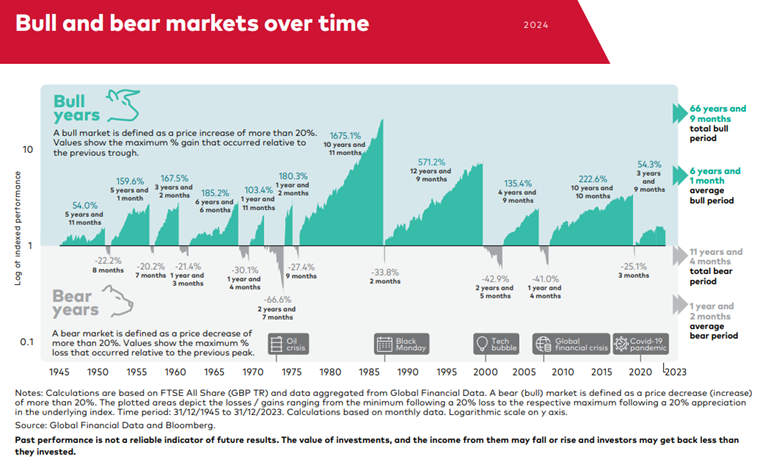
Navigating markets, bull or bear, requires a flexible approach to investment strategies, adapting to market conditions. Understanding the market and how it moves enables portfolio optimisation. This chart about bull and bear runs shows that over a 79-year period to 2023, there were 66.9 bull years (the average bull period was six years and one month), and 11.4 bear years in total (the average bear period was one year and two months). Historically, bull markets have beaten bears and driven long-term gains, proving the practice that investing for the long term and having a disciplined, well-constructed plan can help you reach your goals.
© 2024 Vanguard Asset Management, Limited.
The value of investments can go down as well as up and you may not get back the full amount you invested. The past is not a guide to future performance and past performance may not necessarily be repeated. It is important to take professional advice before making any decision relating to your personal finances. This document does not provide individual tailored investment advice and is for guidance only.
All details are believed to be correct at time of writing – 04 December 2024.